

Safe Enough to Try: Sentence Starters That Actually Get Students Talking
There’s a moment in a lot of classrooms when you ask a question and you're pumped - you just know students have something to say, and… crickets.

Or you get:
“I don’t know.”
One-word answers.
The same two kids carrying the entire conversation.
It’s not always a content issue.
A lot of the time, it’s a language issue.
Students don’t always know how to start their thinking out loud. They’re trying to process the question, organize an idea, find the right words, and say it in front of other people.
That’s a lot.
And when it feels like that, it doesn’t feel safe enough to try.
So, part of our job is not just to ask good questions, it’s to make answering them feel possible.
What this looks like in real life
Instead of asking a question and hoping students jump in, provide them a way in. What should those sentence stems sound like?
If you’re asking about comprehension:
“I think this means…”
“One important detail is…”
“This part shows…”
If you’re asking for evidence:
“I know this because…”
“The text says…”
If you’re asking for thinking or interpretation:
“This makes me think…”
“I wonder if…”
“This connects to…”
Now students aren’t starting from nothing. They’re finishing a thought.
That small shift makes it feel safe enough to try.
Why this works
It lowers the barrier, not the rigor.
Students don’t have to figure out how to say something and what to say at the same time. You’ve taken one task off their plate.
It also changes the feel of the classroom:
More students are willing to speak.
More ideas get shared.
More thinking becomes visible.
And all of this is simply because it feels safe enough to try.
And over time, it builds academic language.
The more students hear and use these structures, the more natural they become. Eventually, they won’t need sentence stems in front of them anymore.
But they will need explicit attention paid to them at first.
What are we actually doing?
This is not giving students the answer.
This is not lowering expectations.
This is giving students access to the thinking you’re asking them to do.
There’s a difference.
Start small
You don’t need a giant anchor chart or a full list of stems.
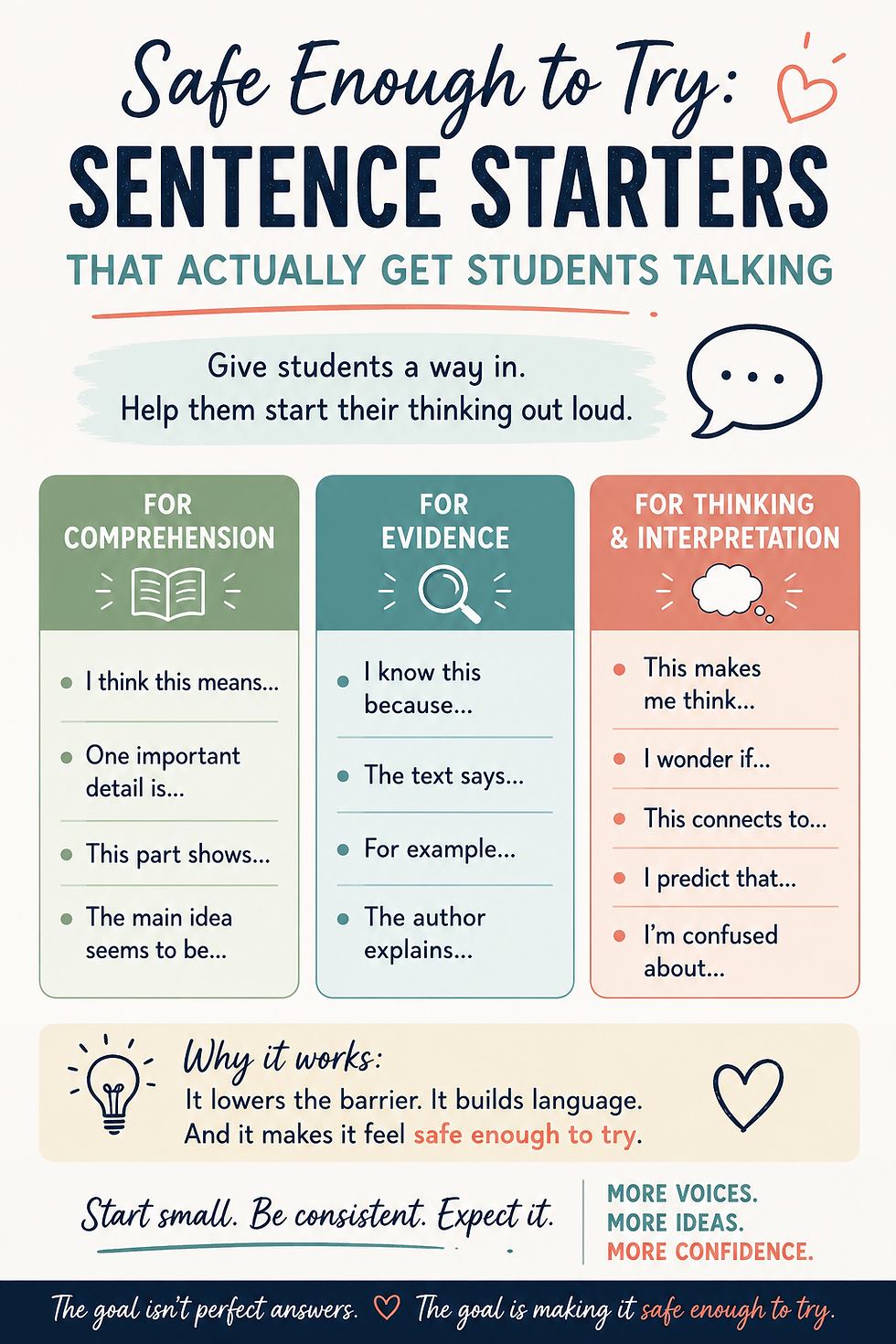
Instead, pick 2-3 that match your lesson and use them consistently.
Say them out loud. Post them. Expect students to use them. Refer to them regularly.
You’ll start to hear the difference pretty quickly.
More voices. More complete ideas. More confidence.
I put together a quick set of sentence starters you can grab and use right away.
No prep. No overthinking. Just something to make it feel a little more safe enough to try. Download it below!
Try this. See what happens. Let me know how it goes.
Make it safe enough to try.
That’s where the real thinking starts.



Comments